
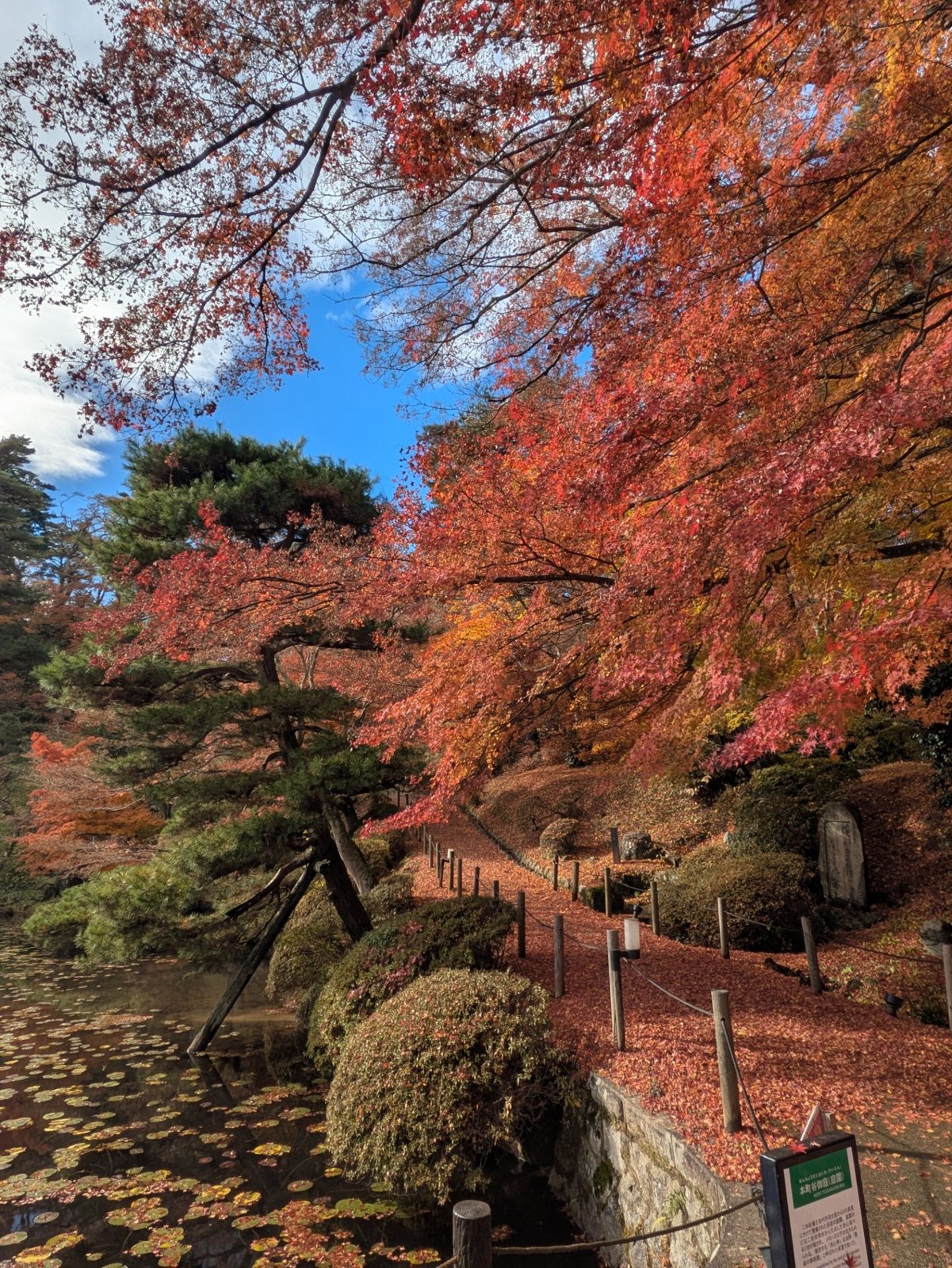
Nihonmatsu Castle (also called Kasumigajo) in Nihonmatsu, Fukushima Prefecture, is No. 11 on the list of Japan’s 100 Fine Castles. There is no keep, but stone walls, the rebuilt Minowa Gate and an Edo-period Japanese garden remain, and in autumn the whole castle turns red with maple leaves. It is also a castle where the story of the Nihonmatsu Boys’ Brigade, the boys who defended the castle in the Boshin War, can still be found along the road from the station.
In this article, we share the highlights, time needed, stamp location, access, and tips for visiting with kids, based on our family trip by train on November 21, 2026.
1. Basic Information Before You Go
| Item | Details |
| Castle (No.) | Nihonmatsu Castle (Japan’s 100 Fine Castles No. 11) |
| Other name / Location | Kasumigajo / 3-chome Kakunai, Nihonmatsu, Fukushima (Kasumigajo Prefectural Park) |
| Built by / Year | Hatakeyama Mitsuyasu / 1414. Niwa Mitsushige arrived in 1643, and it remained the Niwa family’s castle until the end of the Edo period |
| Main remains | Stone walls and keep base of the Honmaru, the rebuilt Minowa Gate, a Japanese garden, and the Senshintei tea house |
| Stamp location | Nihonmatsu Johokan (1F, Nihonmatsu History Museum) and the tourist information office inside JR Nihonmatsu Station |
| Admission | Kasumigajo Park is free. Nihonmatsu History Museum at the Johokan: 200 yen for adults, 100 yen for high school students and younger |
| Opening hours | The park is open at all times. Johokan: 9:00–17:00 (closed Mondays, or the next day if Monday is a holiday) |
| Parking | Kasumigajo Park parking (free) and Johokan parking |
| Time needed | About 2 hours if you take your time with the autumn leaves. With no keep, a quick look takes about 1 hour |
2. [100 Castles Stamp] Nihonmatsu Johokan
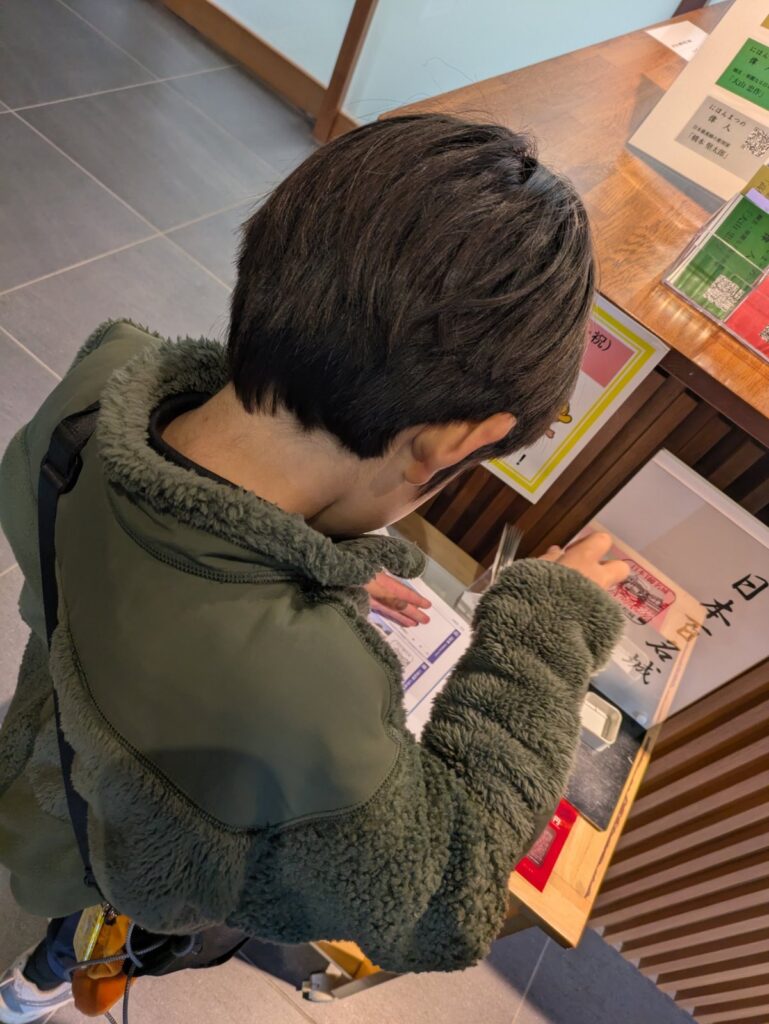
The 100 Castles stamp is kept at the Nihonmatsu History Museum on the 1st floor of the Nihonmatsu Johokan at the foot of the castle, and at the tourist information office inside JR Nihonmatsu Station. We stopped by the Johokan after walking around the castle, and my son stamped his book there. The stamp used to be at a different museum, which has closed, so note the new locations.
3. [On-site Report] Highlights and Dad’s Analysis
[Wish I’d Known Before!] From the Station to the Castle: Up, Then Straight Back Down
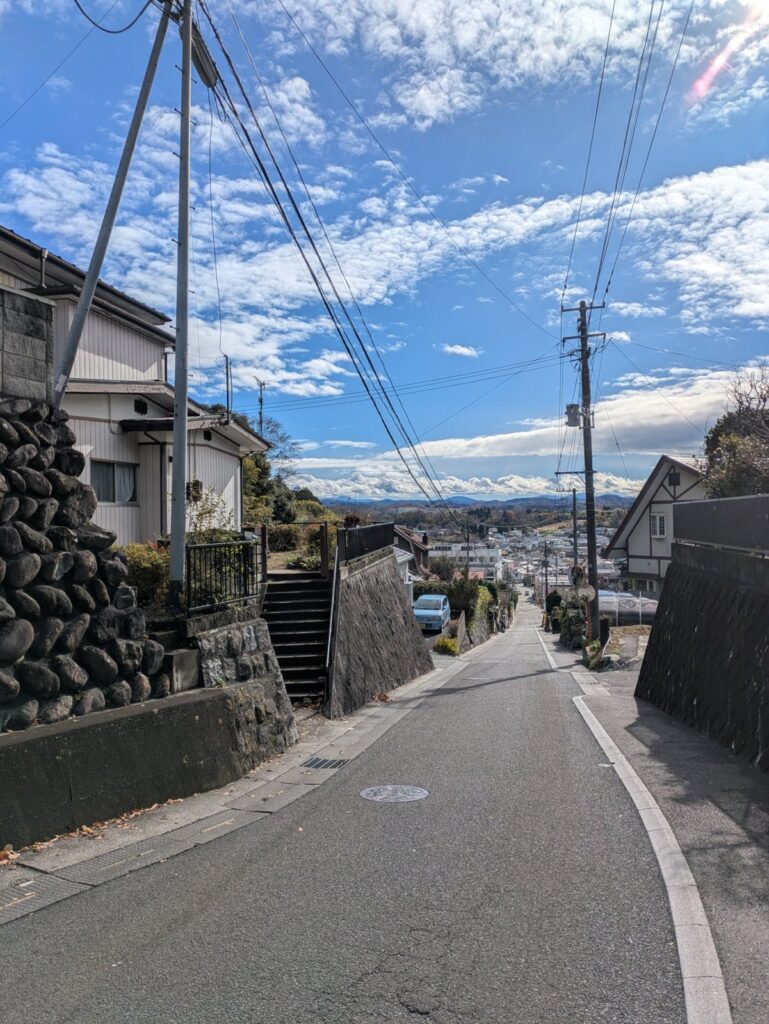
It takes about 20 minutes on foot from JR Nihonmatsu Station to the castle. It feels farther than it looks on the map, and the second half is a long uphill slope. Just when you think you have reached the top, the road goes right back down. Both my son and I complained, “We climbed all the way up just to go down again?!” (lol)
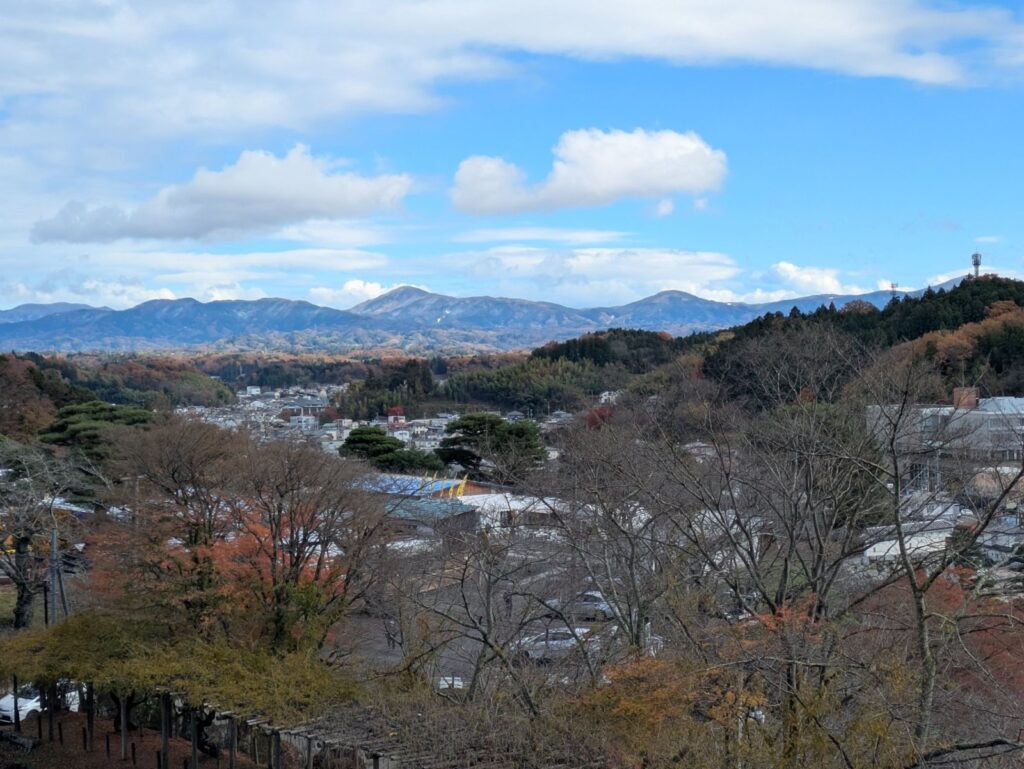
In return, when you look back from the top of the slope, the townscape of Nihonmatsu and the mountains spread out under the blue sky. Partway up the slope stands a monument marking the spot where Ozawa Ikuya of the Nihonmatsu Boys’ Brigade died, a reminder that this slope was also a battlefield.
The Boys’ Brigade Statue at the Station and the Castle Map
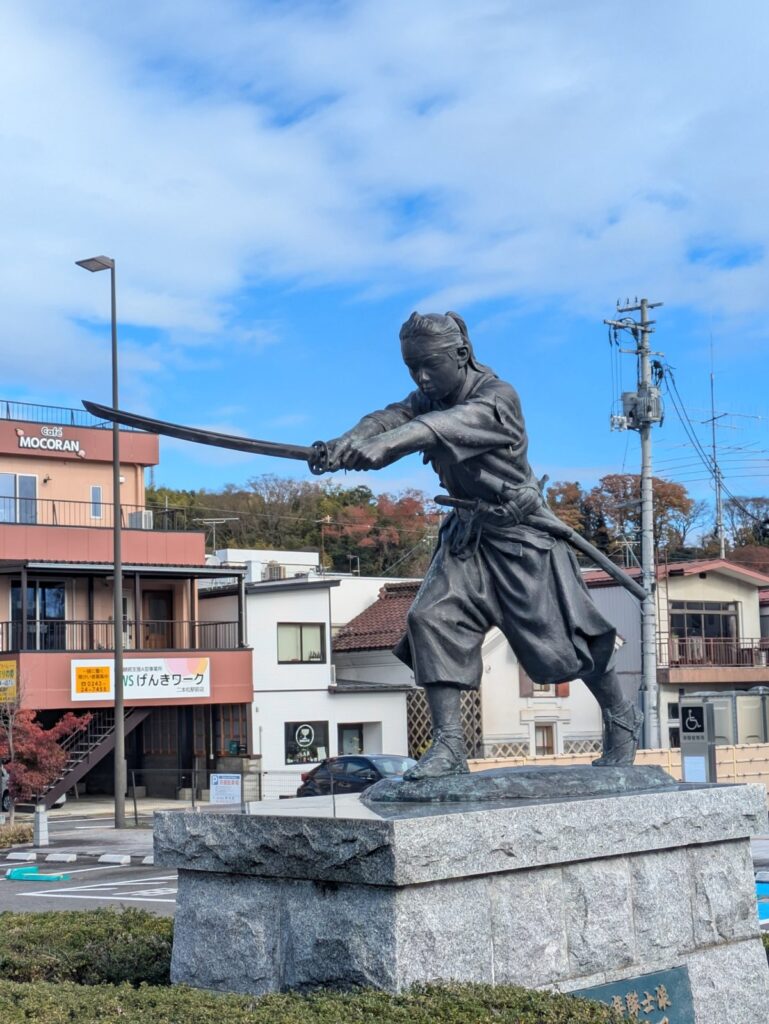
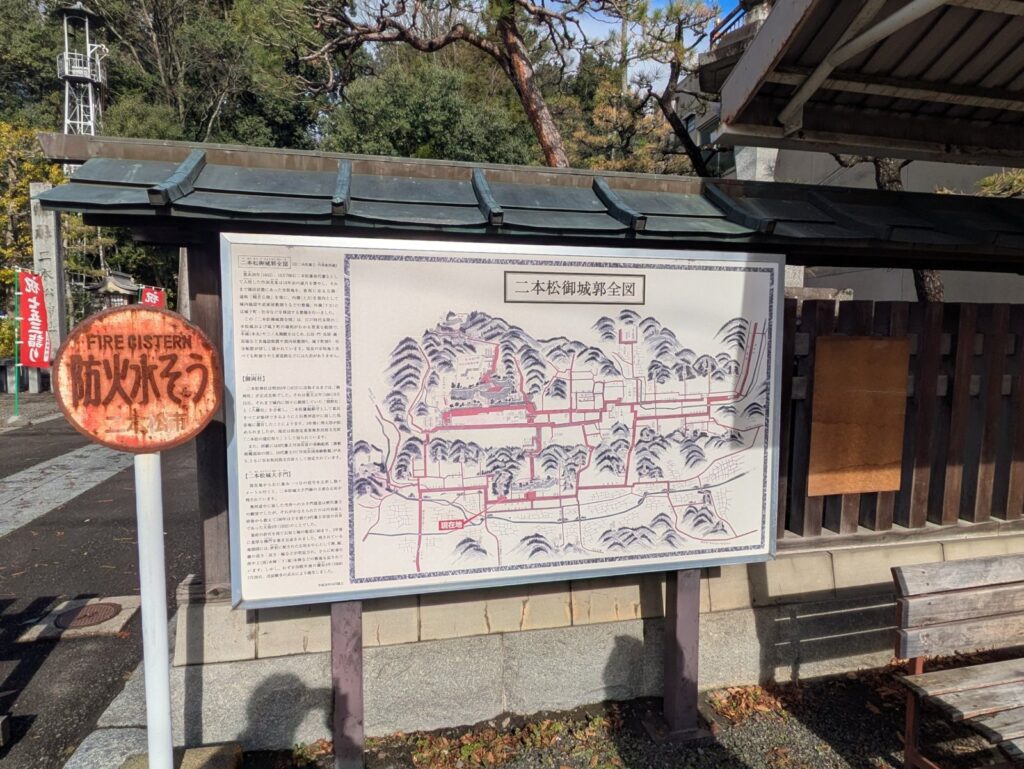
As you leave the station, a bronze statue of a boy holding a sword greets you. On the way to the castle, in front of Nihonmatsu Shrine, there is a sign showing an Edo-period map of the castle and castle town. It shows at a glance how the castle spread across the mountainside, so take a look before you start walking to get your bearings.
The Kasumigajo Monument and Minowa Gate | The First Gate, Built from a Giant Oak
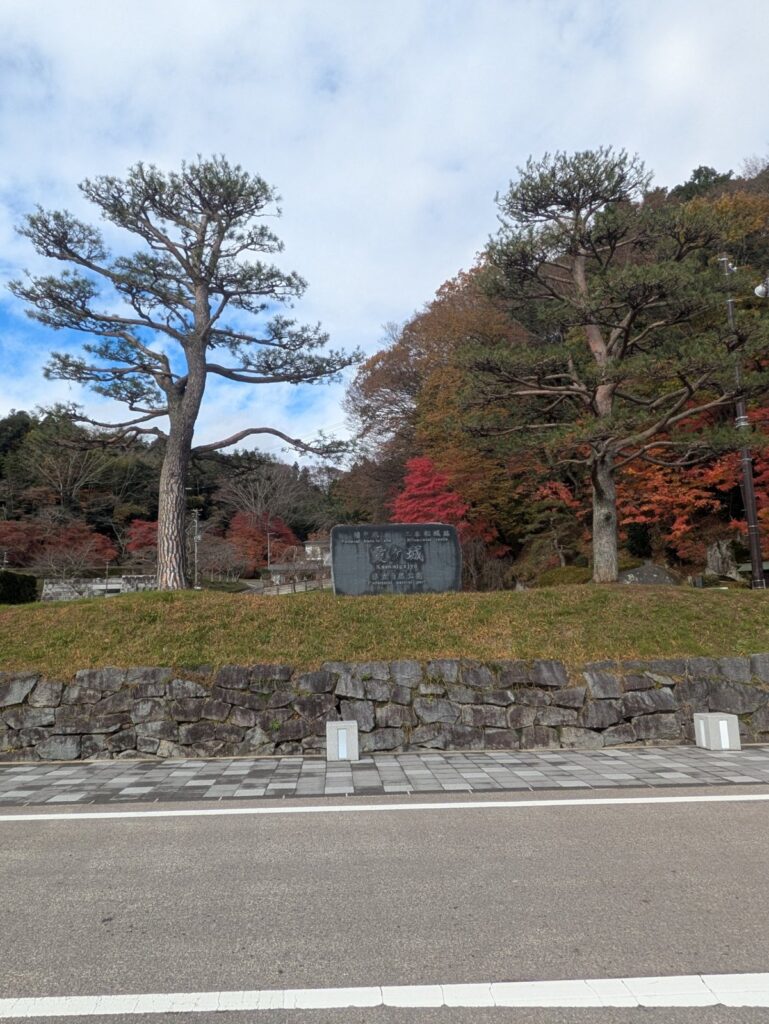
At 10:58, the stone monument reading “National Historic Site, Nihonmatsu Castle Ruins, Kasumigajo” came into view beyond the red leaves.
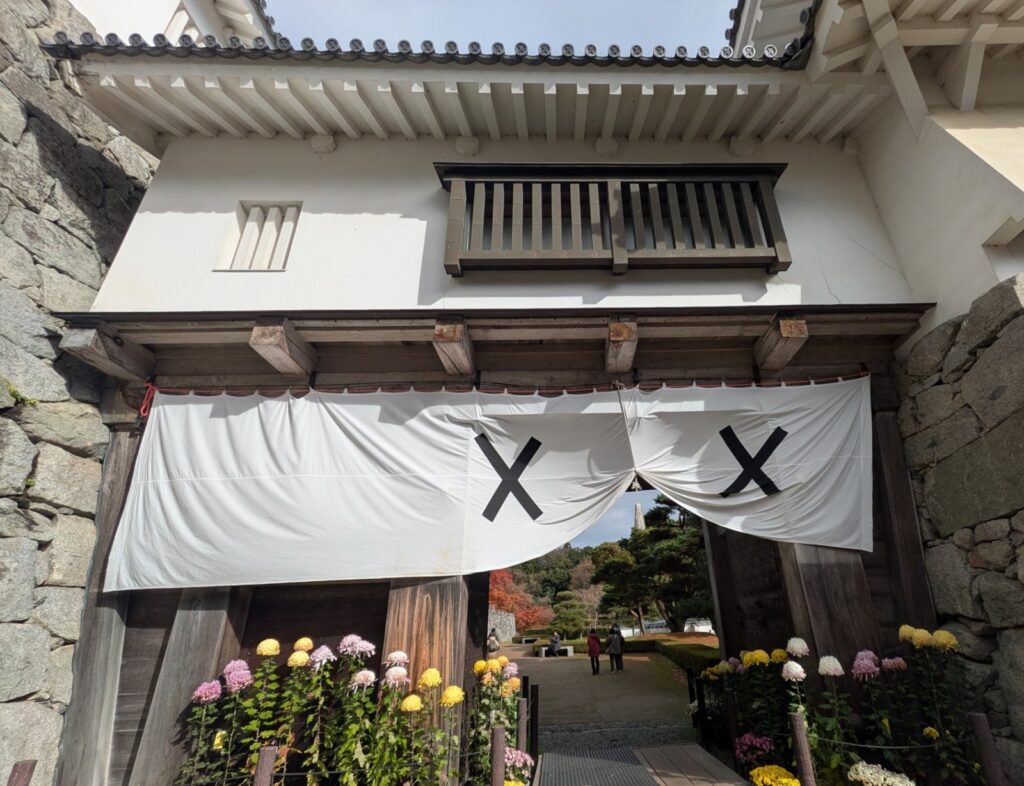
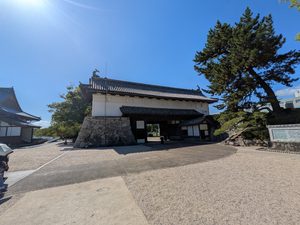
The large turret gate at the castle entrance is Minowa Gate. Niwa Mitsushige built it right after arriving in Nihonmatsu, using a giant oak that was the sacred tree of Minowa village in his domain. It burned down in the Boshin War, and the current gate was rebuilt in 1982. A white curtain with the Niwa family crest (a large X) hangs on the gate, and chrysanthemums lined the front when we visited.
Pines on the Stone Walls and the Corner Stones
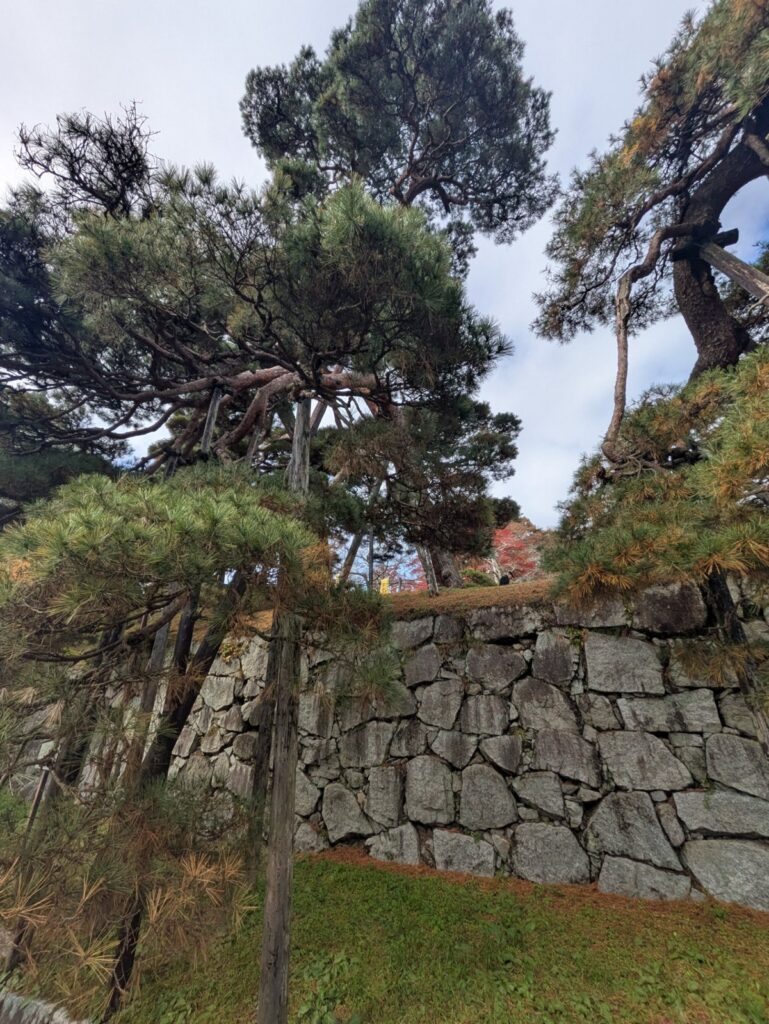
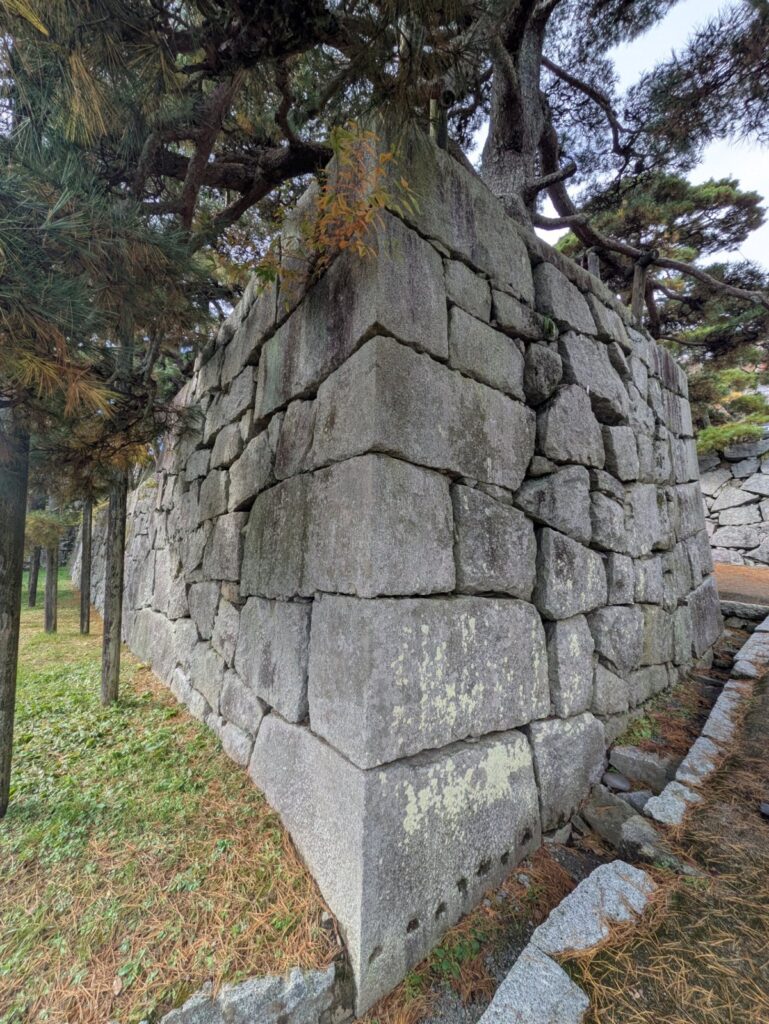
Fine pine trees, propped up with supports, line the top of the stone walls. According to our guide, they have stood here for about 270 years.
At the corners of the stone walls, long stones are stacked alternately, changing direction with each layer. This method is generally called sangizumi and keeps the corners from collapsing.
The Autumn Garden and Senshintei | The Oldest Building in the Castle
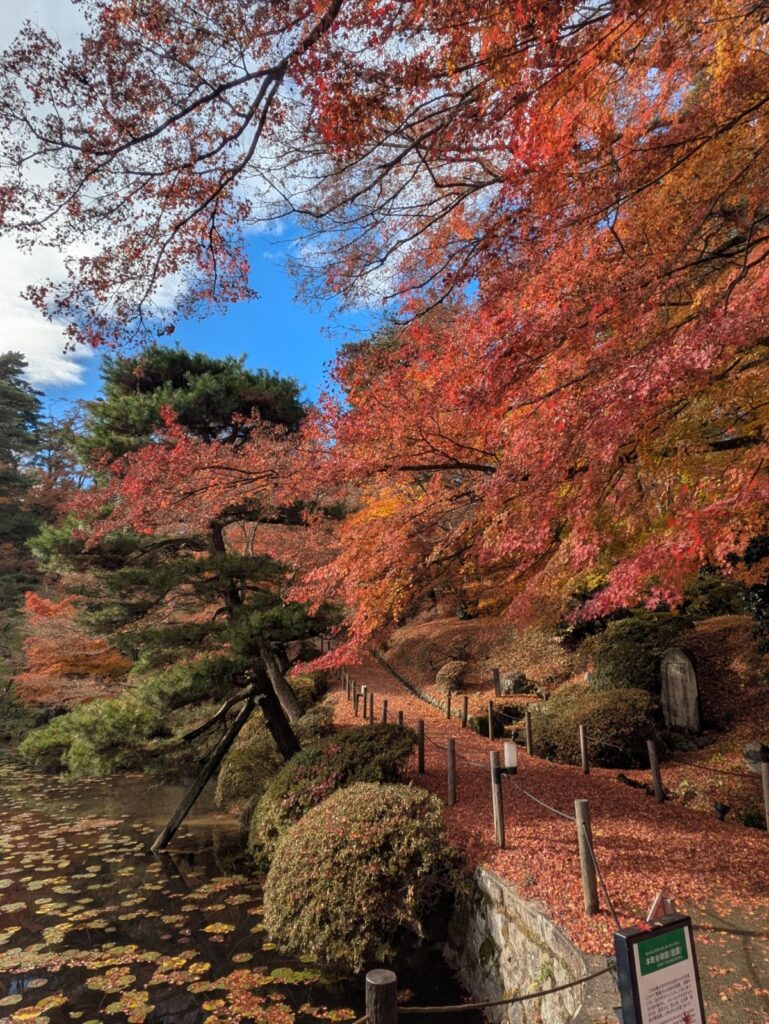
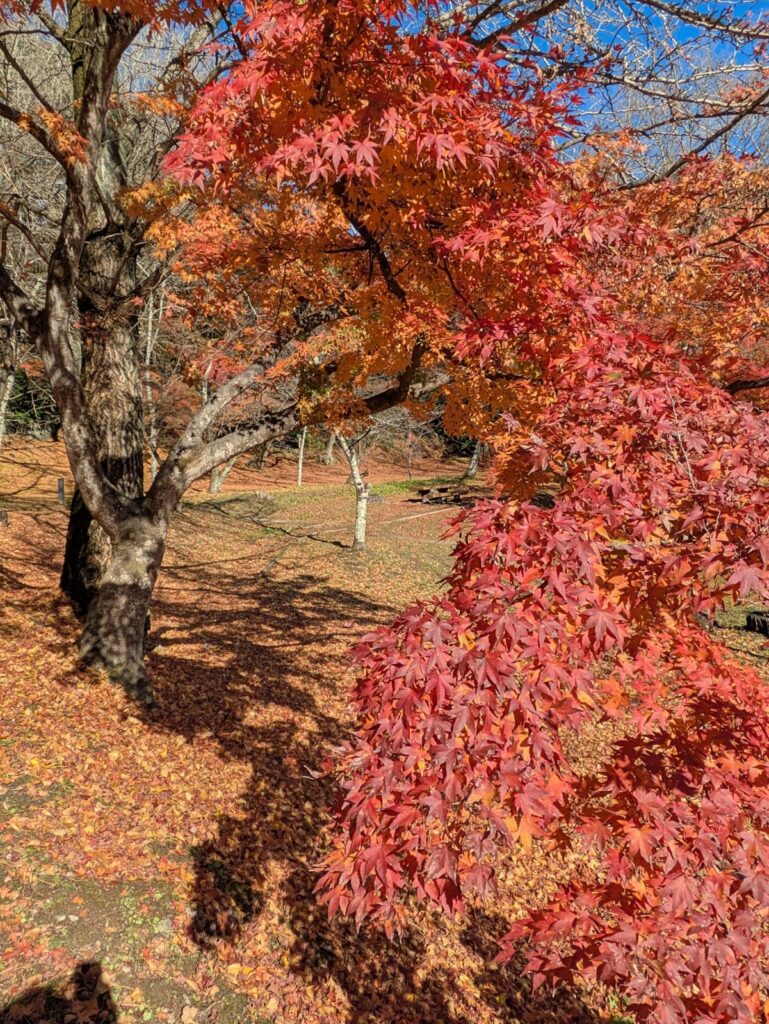
West of Minowa Gate lies a Japanese garden created in the mid-17th century. On November 21, the paths were bright red with fallen leaves, and maple leaves floated on the pond. Autumn colors were everywhere in the castle grounds, and we were really glad we came in this season.
The tea house Senshintei, overlooking the garden, was built in the 17th century and is the oldest surviving building in the castle. It had been moved to the bank of the Abukuma River in 1837, which is why it escaped the fires of the Boshin War. From in front of the tea house you can see the castle town and the mountains beyond.
Ruri Pond and Floating Maple Leaves Down the Stream
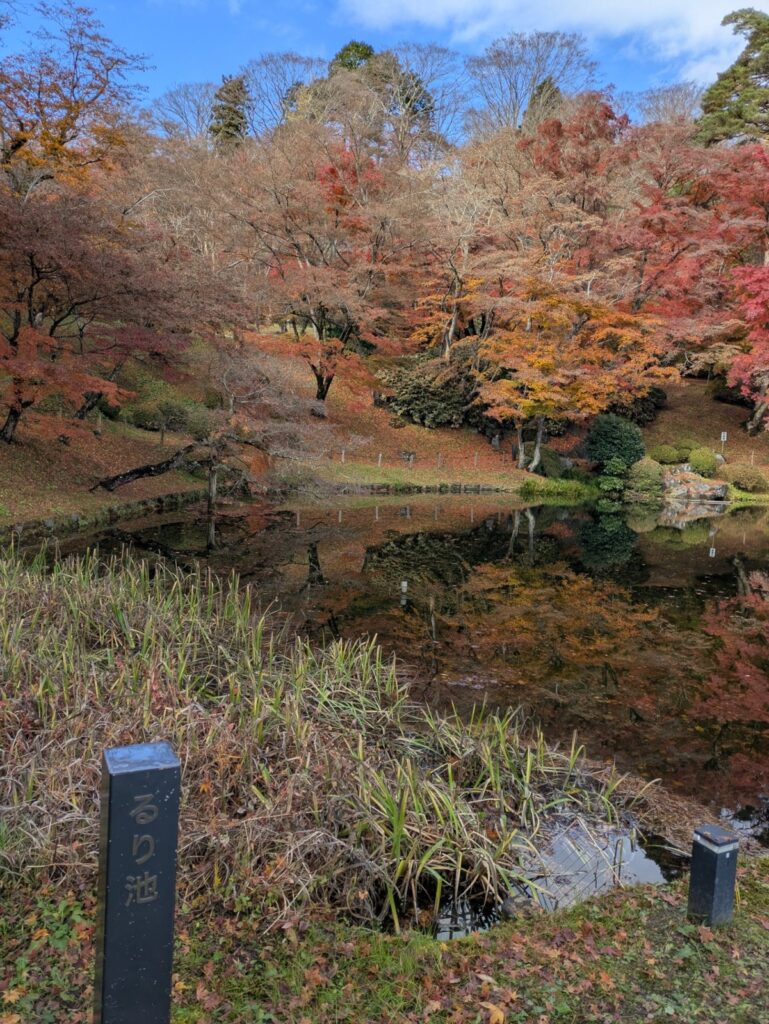
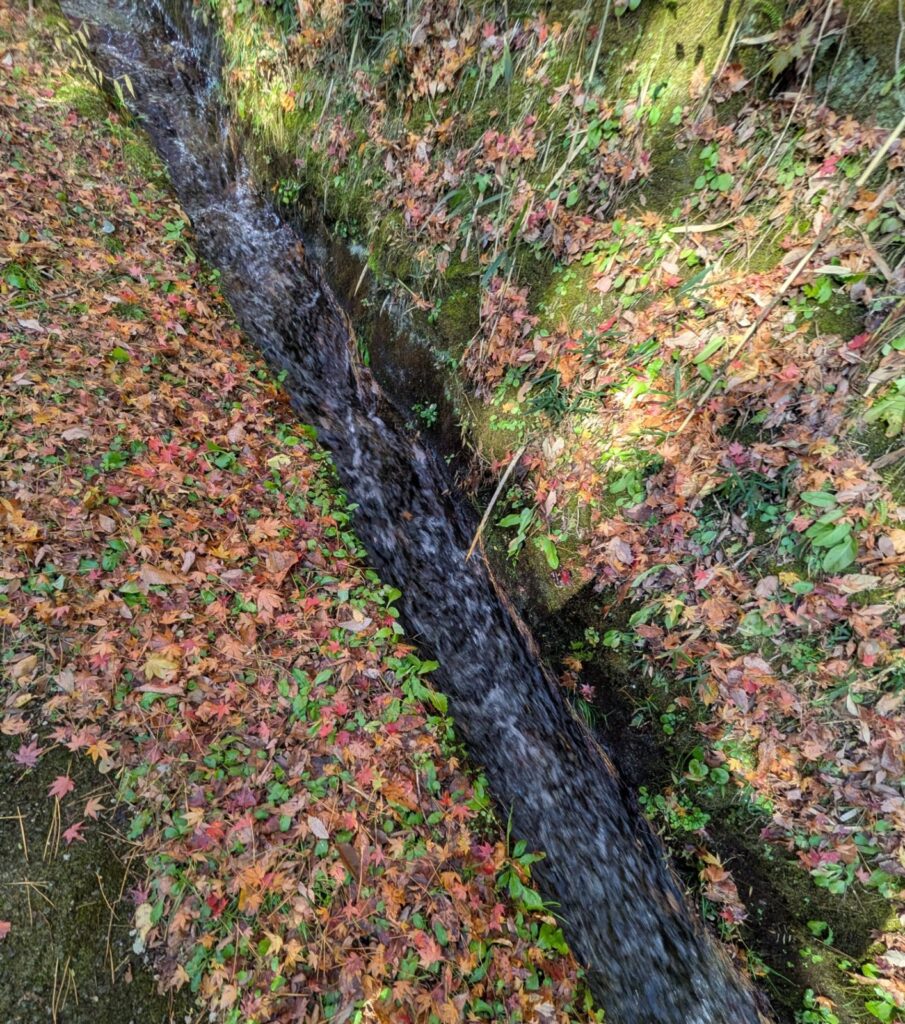
Ruri Pond is a quiet pond where the autumn leaves are clearly reflected on the water. According to our guide, the surface appears to shine lapis blue on March 24. There is also a small, fast-flowing stream in the garden, and we had fun floating fallen maple leaves down it.
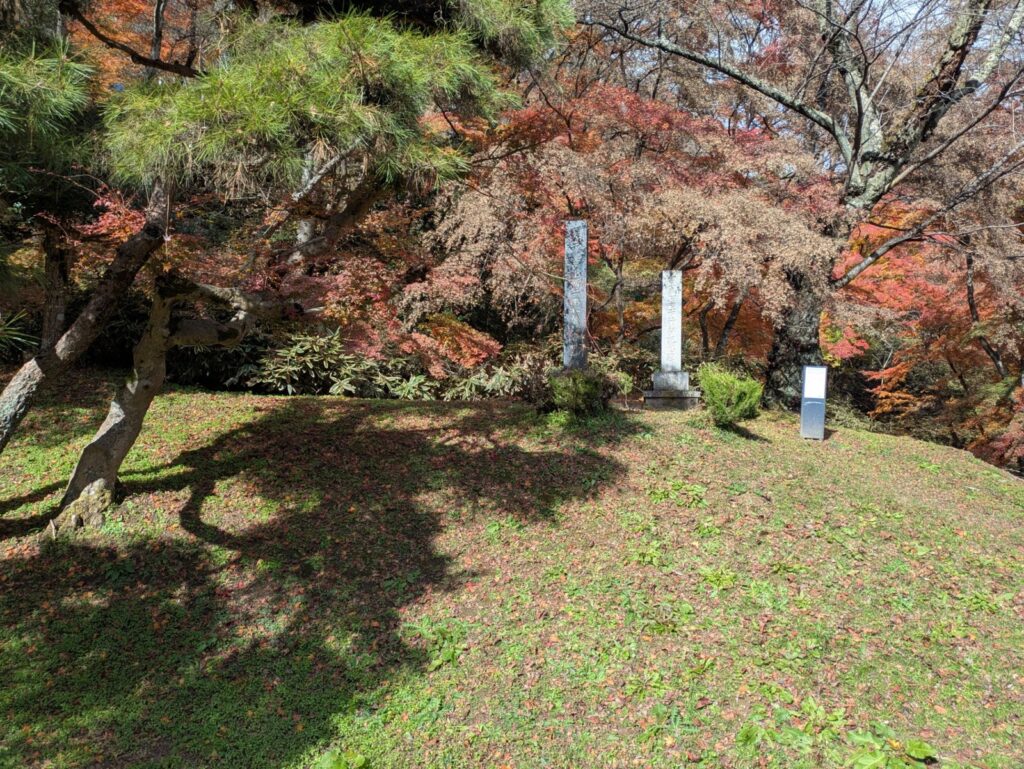
Two stone monuments stand among the autumn leaves; according to our guide, they commemorate a visit by Emperor Meiji. In the Meiji era, a silk mill was built inside the castle grounds and operated only for a short time.
The Honmaru | A 360-Degree Panorama from the Top
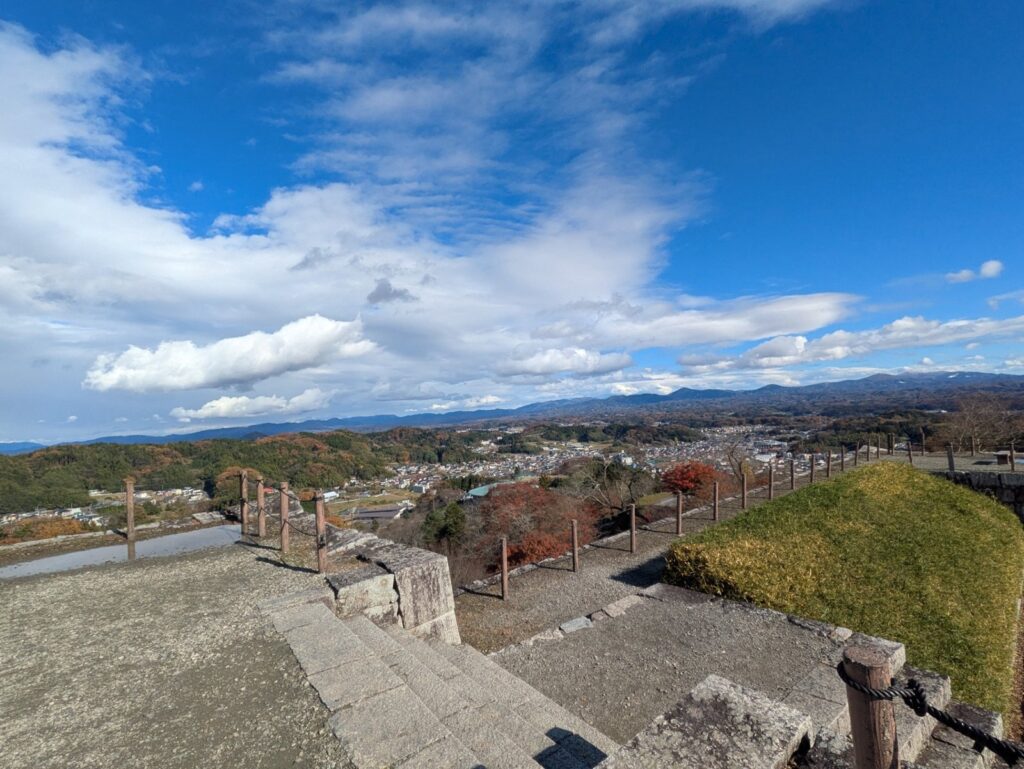
The Honmaru sits at the highest point of the castle ruins. There is a keep base, but a keep was never built. At the top nothing blocks the view, and a 360-degree panorama opens up.
Not many people made it up to the Honmaru. Most of the people we saw at the top had come by car. There seems to be parking higher up as well, so if walking is hard, driving close is one option. If you walk up, you can have the view almost to yourself.
With nothing tall around, you can also take forced-perspective trick photos. We took one where my wife, standing farther back, seemed to be standing on my son’s palm. With only sky and mountains behind, you lose all sense of distance, and it looks like a tiny person is standing on his hand.
4. [Shirolog Special] The Nihonmatsu Boys’ Brigade and the Boshin War
- A castle without its main army: On July 29, 1868, the new government army attacked Nihonmatsu Castle. At that time, the main force of the Nihonmatsu domain was away fighting near Shirakawa and could not get back. Our guide also told us, “Everyone was at Shirakawa, and there was no one at the castle.”
- The difference in strength: The attackers numbered about 7,000 with modern weapons. The defenders were about 1,000, gathered from old men, boys and even farmers.
- The Nihonmatsu Boys’ Brigade: A unit of 62 boys aged 13 to 17, led by Kimura Jutaro, a 22-year-old artillery instructor. The battle was over before noon, and 14 members of the brigade and Kimura were killed.
When people think of boy soldiers, Aizu’s Byakkotai is famous, but the tragedy of the Nihonmatsu Boys’ Brigade happened a month earlier. The Byakkotai was one of the age-based units formed by the Aizu domain, separate from the Nihonmatsu Boys’ Brigade. The statue at the station, the monument on Kubocho slope, the group statue outside Minowa Gate — memories of that day remain all along the road we walked. These were children only a little older than my son, and as a parent the story stayed with me.
5. Guide for Families with Kids
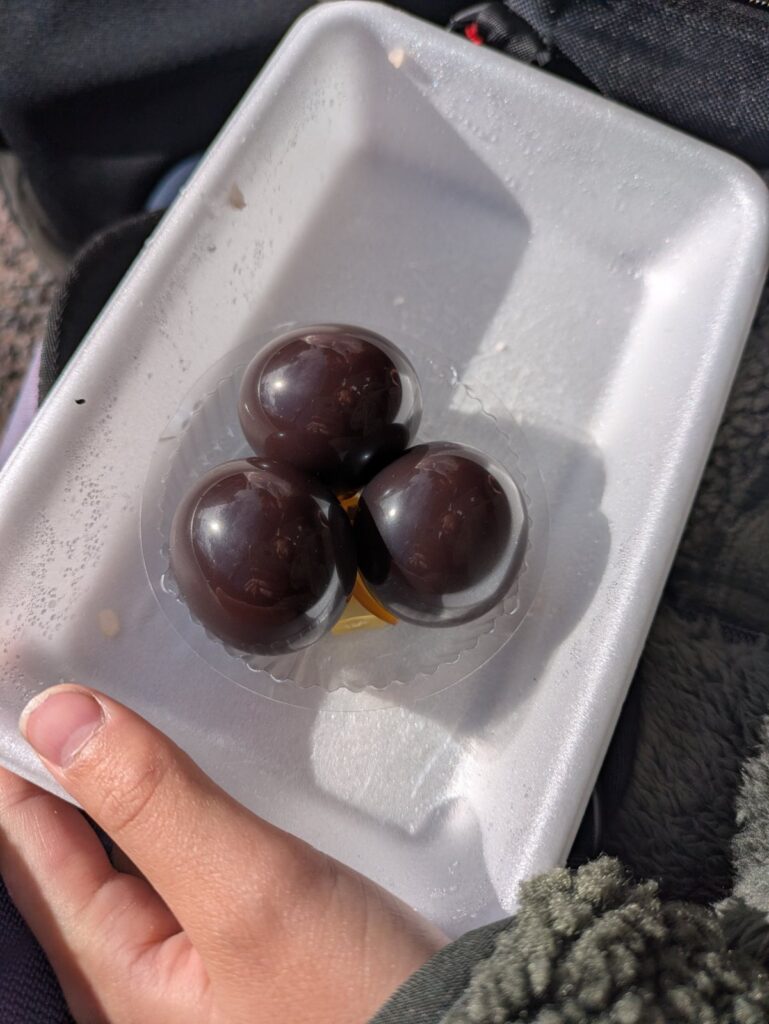
- My son’s reaction: He complained on the slopes, but loved popping the ball-shaped yokan with a toothpick. He floated maple leaves down the stream in the garden and played in the fallen leaves, and enjoyed himself to the end.
- Dad’s notes on footing: There are ups and downs all the way from the station to the castle and from the castle grounds to the Honmaru. Comfortable shoes are a must. With small children, or if slopes are hard for you, consider a taxi or car.
- Volunteer guide: Our guide explained everything carefully, right down to the stone walls and pine trees. Listening closely takes time, so leave plenty of time for your visit.
- Food: There were food stalls when we visited, so we could have a light bite (they may just have happened to be there). We also had sekihan (red bean rice) at Tamashimaya.
6. Tips for Your Visit | Autumn Leaves and a Preview at the Johokan
- Autumn leaves: The peak is usually said to be early November, but on November 21 the garden was still bright red. The Nihonmatsu Chrysanthemum Doll Festival is also held in autumn.
- Preview at the Johokan: If you walk from the station, learning Nihonmatsu’s history at the Johokan before the castle helps you understand the monuments and statues inside.
7. Souvenirs for Castle Hunters
Tamashimaya, a long-established Japanese sweets shop about 5 minutes on foot from the station, is famous for tama-yokan, round yokan (sweet bean jelly) sealed in a rubber balloon. Prick it with a toothpick and the rubber peels away in one go — kids love it. Prices at the shop when we visited were 1,512 yen for 10 and 2,214 yen for 15. Inside there is also a giant tama-yokan display equal to 700 pieces. Tamashimaya has seats both outside and inside, and we sat down right after buying to eat tama-yokan and sekihan. It also makes a good light snack.
8. Access
- Train: About 20 minutes on foot from JR Tohoku Main Line “Nihonmatsu Station”. The route has uphill and downhill slopes.
- Car: About 5 minutes from the Nihonmatsu IC on the Tohoku Expressway. Kasumigajo Park parking is free.
9. FAQ
Q. Can I walk from Nihonmatsu Station to the castle?
A. Yes. It takes about 20 minutes on foot, but the road has uphill and downhill slopes.
Q. Is there an admission fee?
A. Kasumigajo Park is free. The Nihonmatsu History Museum at the Nihonmatsu Johokan charges a fee (200 yen for adults).
Q. Where can I get the Japan’s 100 Fine Castles stamp?
A. At the Nihonmatsu Johokan (1F, Nihonmatsu History Museum) and the tourist information office inside JR Nihonmatsu Station.
Q. Is it fun for kids?
A. Yes. The slopes are tough, but with the tama-yokan, playing in the fallen leaves and the stamp, our elementary-school son enjoyed it to the end.
10. Summary
Nihonmatsu Castle is worth the climb from the station, full of autumn colors, stone walls and the story of the Boshin War. Kids can enjoy tama-yokan and playing in the leaves, while adults can take in the history of the Boys’ Brigade and the view from the Honmaru — something for everyone in the family.
Prices and hours are based on official information at the time of our visit. They may change, so please check before you go.




Comments